

Why Some Families Get Richer Even When They Lose Money
Put $100 into something everyone’s hyping, and watch it crash to $2. That’s not a bad month. That’s 98 cents of every dollar gone. Now picture the person who built the thing you just lost money in. Same crash. They walk away richer. Same event, two completely different endings.
That’s not luck. That’s a closed loop. And once you see how it works, you can build your own small version of it — for your family, on purpose, starting now.
I’m TK, founder of Thrive Wisely. Let’s break down the street version of this game, then the kid version, then exactly why it’s the actual mechanism behind generational wealth — not just a lucky win.
The Closed Loop: How Money That Stays Owned Multiplies
Create Companies — The Street-Level Playbook
Here’s the play, four steps, no fluff:
Step one: you create something that prints your own money — a coin, a fund, shares in a company you control. Step two: you get other people to pay real money for a piece of it. Step three: you take that real money — money that used to belong to everyone who bought in — and you convert it into real things: property, buildings, assets that don’t disappear. Step four: everyone else is left holding a coin that might crash to nothing, while you’ve already turned their money into something real that you own outright.
That’s the closed loop. The money went in from the outside, got converted to real assets on the inside, and it never has to come back out to “prove” anything. You already won the moment you cashed out into something real — whatever the coin does after that is somebody else’s problem, not yours.
Here’s the part that matters for you: this is not permission to go run this on other people. My rule, plain and simple — we’re not here to take from people to get ahead. We’re here to learn the mechanism so we can use it for our own families and our own community, not against somebody else’s. Once you can see these four steps, you’ll notice them everywhere — in the news, in your own city, in industries that have nothing to do with each other on the surface. The steps are always the same.
The Kid Version: Jalen’s Chips
Picture a kid named Jalen at recess. Jalen invents his own poker chips. To play his game, every kid has to trade real allowance money for Jalen’s chips first. Now Jalen’s holding a pocket full of real dollars from every kid who wants in.
Jalen doesn’t spend those dollars on the game. He takes them straight home and buys a real bike. Now he owns something real that exists no matter what happens at recess tomorrow. Meanwhile, every other kid is still sitting there holding a pocket full of Jalen’s chips. If Jalen quits the game, or prints a hundred more chips out of nowhere, those chips could be worth nothing by lunch. Not Jalen’s problem — he already turned real money into a real bike before anything went wrong.
That’s the exact same four steps as the street version above, just small enough to see all at once. Own the machine, not the ticket.
Why This Builds Generational Wealth — Not Just One Big Win
Here’s the piece most of us never get taught: the real power of a closed loop isn’t the one big payday. It’s what happens when the money stays inside the loop and keeps compounding, year after year, before it ever gets passed down.
Say a family buys a small rental property together for $20,000 — a $20,000 asset that earns $300 a month in rent after expenses. That’s $3,600 a year staying inside the family’s loop instead of leaking out to a landlord. Over 10 years, that’s $36,000 in rent alone, on top of the property itself likely being worth more than $20,000 by then. None of that money ever left the family’s closed loop to go rent an apartment or buy someone else’s chips. It just kept compounding, inside the circle, the whole time.
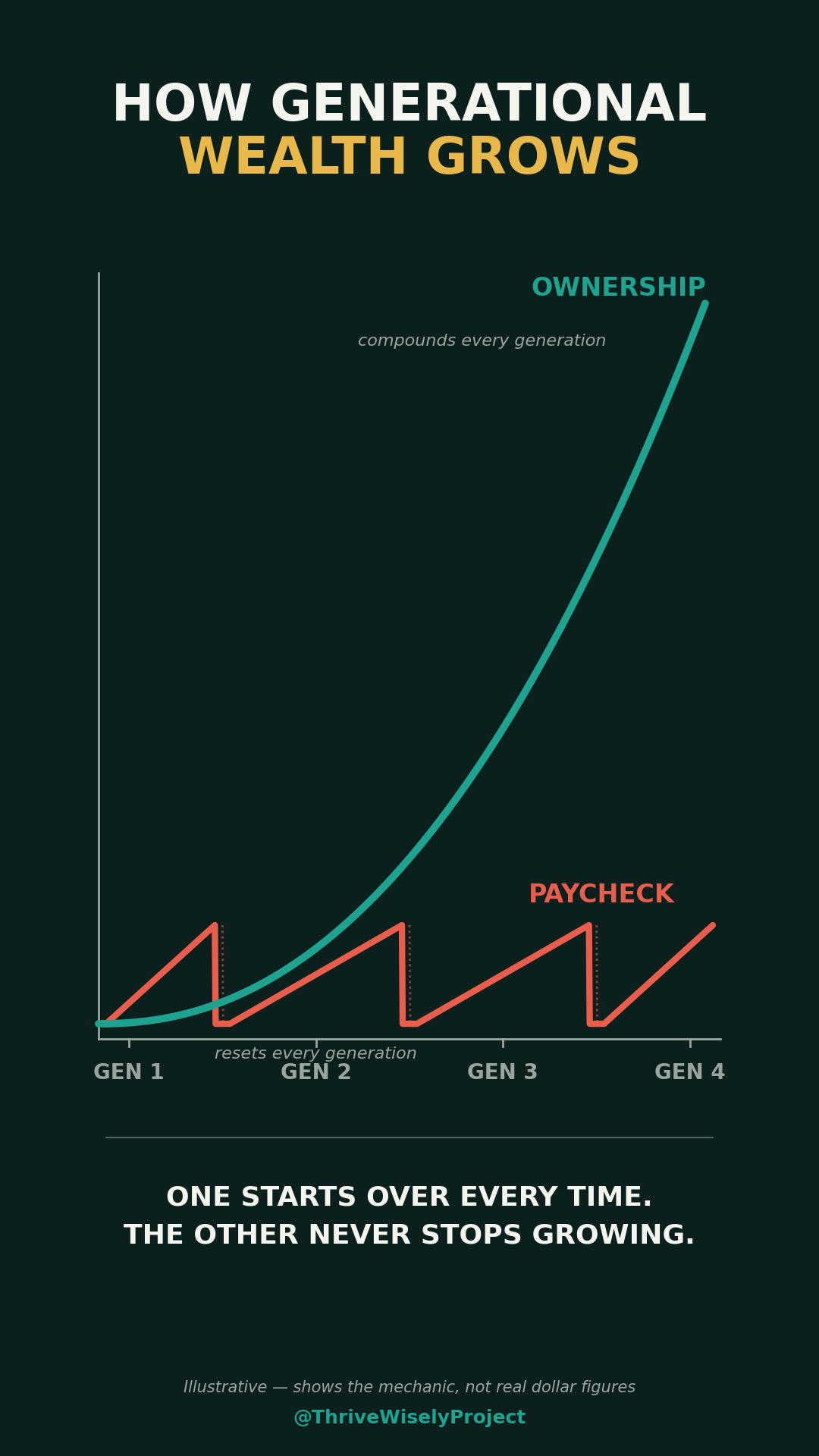
Now the kids inherit a paid-down property that’s already worth more than what their parents put in — plus they watched the whole thing happen, so they know exactly how to do it again, faster, with their own money. That’s generational wealth: not one lucky $100 turning into millions, but money that never left the loop, magnifying quietly for years, handed down already bigger than it started.
Run the math one more way, because this is the part that actually matters. If that same $36,000 in rent over 10 years had instead been spent on rent payments to someone else’s property, the family would own nothing at the end of it — same $36,000, zero asset. Inside the loop, that $36,000 plus the property itself becomes the next generation’s starting line. Outside the loop, it just disappears into someone else’s closed loop instead. Every dollar is always inside somebody’s loop — the only real question is whether it’s inside yours.
Community — Building Your Own Closed Loop
You don’t need a company or a coin to start your own version of this. A closed loop just means: money that stays owned by people who trust each other, instead of money that leaks out to rent, fees, or someone else’s chips.
A few friends each put in $50 a month into shares of real companies — $250 a month combined, owned together, staying in the loop. A family buys one rental property instead of five separate people each renting an apartment. A small business run and owned by family, where profit gets split by ownership, not paid out and gone. Even a joint savings account earmarked for a first shared investment counts — the loop doesn’t have to be big to start, it just has to stay closed instead of leaking out to rent, fees, and other people’s chips.
Small loop, same mechanism, same compounding — just sized for a real paycheck instead of a billion-dollar deal. The families who look “lucky” from the outside almost always just started their loop one generation earlier than everyone assumes.
Is this the same thing as a pyramid scheme?
No — and that distinction matters. A scheme is designed so the only way to win is for someone else to lose their money permanently, with nothing real ever built. A closed loop done right builds something real — a property, a business, real shares — that keeps earning for everyone inside it. The line is simple: are you building something real together, or just hoping the next person pays in before the music stops?
The bottom line
The families who stay rich no matter what the market does aren’t smarter than you. They just figured out that money left inside a closed loop — owned, reinvested, never fully cashed out — multiplies quietly for years before anyone even inherits it. You can start your own small loop this month, at whatever size actually fits your life. If you want the rest of the framework — Cash, Credit, Compassion, Community, and Create Companies — mapped to exactly where you’re at, type THRIVE and I’ll send you where to start: https://thrivewisely.org/join
You’ve got this.
— Tonya “TK” Kinlow, Founder, Thrive Wisely. 26+ years in Fortune 500 finance leadership (Divisional CFO, GE) and 10 years as fractional CFO for startups and midsize companies (PromiseOne Companies) — “Your Neighborhood CFO,” here in Cleveland.
